When to Launch a Fee-for-Service Program at Your Nonprofit
Let's talk about choosing a launch date!
Your organization has decided to introduce a paid service. When should it launch?
It’s tempting to pick a date based on when you want the revenue to start rolling in. Which is usually as soon as possible! Or to work backward from a funding deadline, a board meeting, or the end of a grant.
But your launch date is also the start of new operational work for your team, and there's some strategic thinking involved to ensure your launch is successful!
A Fee-for-Service Launch Is More Than a Date
Introducing a fee-for-service offer, even as a pilot program, can impact multiple areas of your organization.
Your team may need to:
- explain the change,
- answer questions,
- prepare quotes,
- adjust familiar processes, or
- have conversations that feel uncomfortable at first.
And your community may need time to understand what’s changing and what it means for them.
We've just identified training, communications, operations, finance, partnerships, and marketing impacts to your organization.
And whether you have a team of 2 or 200, this work will take time. Even more so if this is your first revenue-generating offer.
A team that has space to prepare is more likely to feel confident supporting the change. And that confidence can help your community feel reassured.
What Your Funding Calendar Can Tell You
I recently created a funding calendar for a course assignment. I focused on a Canadian research grant competition and the research networks that support applicants. And mapped out the work pre and post grant application deadline.
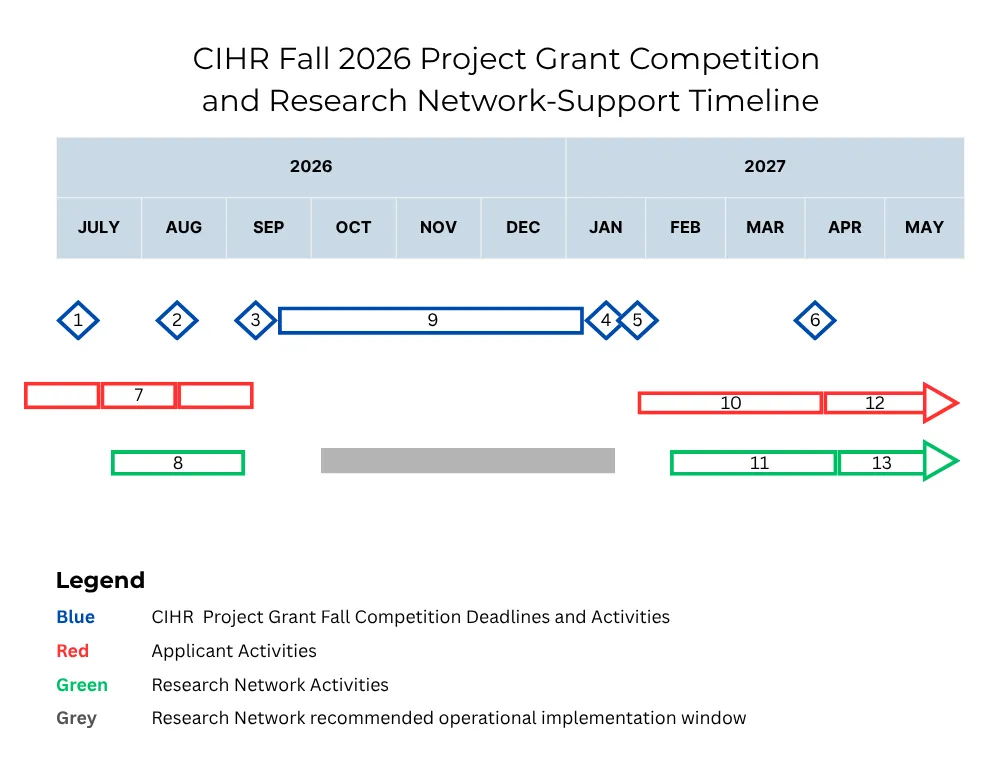
Funding Calendar Assignment #1 for the Canadian Res Funding Env Intro course, Fall 2026
The calendar mapping showed that the grant deadline was the tip of the iceberg. There's flurry of work that happened before the deadline. In this case, networks may receive requests, assess whether they can offer support, approve commitments and prepare letters of support. And after funding decisions are announced, there is another flurry of activity to confirm research project scope, timelines and support details.
Looking at those activities on a calendar made the peak workload weeks obvious. And also showed the less busy periods of time that could be potential launch windows, which is the grey zone.
The same approach works for nonprofit organizations too. You might have grant applications, reporting deadlines, fundraising campaigns, seasonal programs, or periods when the community needs more from you.
And while some of that work is blocked off on a calendar, some probably isn’t.
**If the work isn’t visible, launching a fee-for-service offer in the middle of a peak workload period creates a risk of the team being overcapacity.
What can you do?**
Find a Launch Window That Works for Your Team
First, two definitions:
Launch window: A period of time that a launch date could be within. It is only shared internally, and used for planning purposes. Example: “Our proposed launch window is Feb 20 - March 10, because of …..”.
Launch date: A single calendar date where the offer will be published and available to your community. Example: “Starting March 1, we will be offering ….”.
A good time to launch isn’t necessarily your slowest month. It might be slow because everyone is on holidays, or your community isn’t as active and therefore won't see your offer.
Ideally, you want to introduce a service just before a busy season begins, giving your team some time to get comfortable with the process before demand picks up.
You’ll also want to consider when the people who are likely to purchase your offer are most likely to be interested.
Borrowing ideas from Corporate Product Launch Planning
I led, participated, and consulted on business product launches for years. And the best launch window didn't always line up with the best time to do the project work.
We found ways to solve that problem. Consider the three stages of work.
- The project, which is all the behind-the scenes activity your team does to get the offer ready.
- The launch date itself, which means sharing it with your community.
- And operationalizing the offer, delivering it as promised while also gathering feedback and iterating as needed.
Idea #1: There can be a time gap between the project work and the launch date. Do all of the project activities, get your offer ready, and then let it sit on the shelf until you’re ready to launch. Maybe it’s 3 weeks. Maybe it’s 2 months.
Idea #2: There cannot be a time gap between launch date and operationalizing. Once the offer is out there, you’ve made a promise to your community, and need to be ready to keep that promise.
There's no rule that a project needs to launch as soon as the project work is complete. But once it's launched, you do need to be prepared to follow through. The launch is the starting point.
Questions to Consider Before You Choose a Launch Date
There can be a lot of pressure to choose the soonest possible date, for a variety of reasons. Financial urgency. Board expectations. Community need.
Before you share a launch date with your team, your Board, or your community, ask yourself:
- What work happens before and after the major dates on our calendar?
- What will our team need time to prepare for?
- When will the people we serve be ready to hear about the offer?
- What else is happening during our proposed launch window?
- Could we add a time gap between project work and the launch?
Wrap Up
Your launch date shouldn’t simply be the earliest possible day your offer will be ready. Recognize that it's the point where your project work ends and your promise to deliver begins.
Choosing a launch window that considers your team’s capacity, existing commitments, and your community’s needs gives your offer the greatest opportunity for success.
About Susan

Susan Gongal helps nonprofits and research networks explore unrestricted revenue in mission-aligned ways. After nearly 20 years in the corporate world, she found a new kind of fun in helping teams balance purpose and revenue. Join her weekly email community, Revenue, Within Reason, for practical ideas and tools.
© 2026 Surge Advisory Inc.